

Robert Kiyosaki's Rich Dad Poor Dad, first published in 1997, has sold millions of copies worldwide. But for the African youth, the book offers something more than personal finance advice. It offers a mindset shift—a way of seeing money that challenges the very systems that have kept generations trapped in the "rat race." A rat race is a fierce, endless and tiring daily routine where people compete hard for money, power, or status.
This is not a review. It is a call to action for every young African who wants to understand why some people build wealth while others simply earn a salary.

The Two Dads: A Tale of Two Mindsets
The power of Rich Dad Poor Dad lies in its simplicity. Kiyosaki tells the story of two father figures in his life: his biological father (the "poor dad"), a highly educated government employee who believed in job security and working for money and his best friend's father (the "rich dad"), a businessman who believed in making money work for him.
The poor dad said, "Love of money is the root of all evil." The rich dad said, "Lack of money is the root of all evil."
The poor dad worked for a paycheck. The rich dad built assets that generated income while he slept.
The poor dad saw his house as his greatest investment. The rich dad saw it as a liability that drained cash from his pocket every month.
This is the fundamental lesson that African youth must internalize: the difference between wealth and poverty is not how much money you earn, but how you relate to money.
The One Lesson That Changes Everything: Assets vs. Liabilities
If you take nothing else from Rich Dad Poor Dad, take this: An asset puts money in your pocket (pays you). A liability takes money out of your pocket (costs you).
Kiyosaki argues that most people struggle financially because they do not understand this distinction. They buy things they think are assets—a house, a car, the latest phone—but which are actually liabilities that drain their income every month.
For young Africans, this lesson is urgent. In economies where formal jobs are scarce and wages are often low, the temptation to spend on status symbols is powerful. But as Kiyosaki warns: "Rich people acquire assets. The poor and middle class acquire liabilities that they think are assets."
The path to financial freedom begins with a simple question: Does this thing I am about to buy put money in my pocket, or take it out?
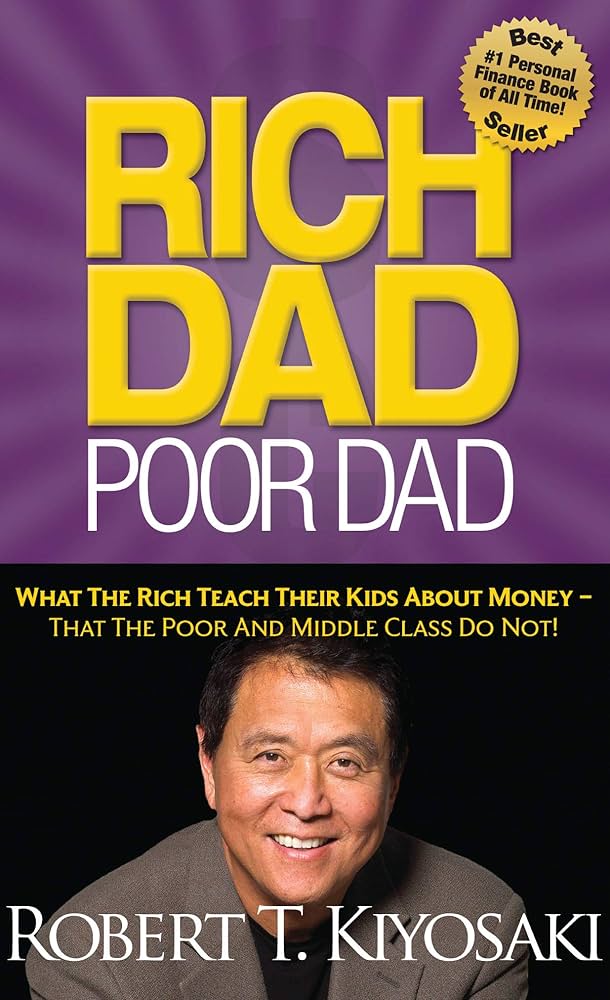
Rich Dad, Poor Dad -- What The Rich Teach Their Kids About Money - That The Poor And Middle Class Do Not!
Beyond the Rat Race: Why This Book Matters for Africa
Tony Elumelu, one of Africa's most successful entrepreneurs, has said that "knowledge is the greatest tool for creating wealth and lifting people out of poverty." He has called for the "democratisation of prosperity" across Africa through financial literacy, arguing that teaching individuals to save and invest creates stronger foundations for capital formation than simply distributing money.
This is precisely what Rich Dad Poor Dad does. It democratizes the knowledge that has historically been reserved for the wealthy—knowledge about how money actually works, how to build assets, and how to escape the cycle of working harder for less.
The numbers tell a compelling story. By 2050, one in four workers globally will be African. The continent's youth are already innovating—coding apps, launching businesses, reshaping industries. But without financial confidence, many of these ventures will fail not because the ideas are bad, but because the founders do not understand the fundamentals of money management.
The Rich Dad Mindset: What It Actually Means
Adopting a "Rich Dad mentality" is not about greed or materialism. It is about understanding the rules of the game.
The rich don't work for money. Kiyosaki writes: "The poor and the middle class work for money. The rich have money to work for them." This means building systems and assets that generate income, rather than trading time for a paycheck.
Financial literacy is not optional. "Intelligence solves problems and produces money," Kiyosaki says. "Money without financial intelligence is money soon gone." Learning about accounting, investing, markets and law is not for accountants and lawyers alone. It is for anyone who wants to control their financial future.
Take calculated risks. Kiyosaki argues that "losers are people who are afraid of losing." Smart risk-taking, paired with knowledge and rational thinking, is essential for wealth creation. The first investment may not be perfect, but it makes you smarter for the next one.
Mind your own business. This does not mean neglecting your job. It means building something that belongs to you—a side venture, an investment portfolio, a business—that generates income beyond your salary.
Understand how taxes work. Kiyosaki explains that the rich use corporations to legally reduce their tax burden. While employees are taxed on their income before they can spend, corporations earn, spend and then are taxed on what remains. This is a powerful incentive to become an entrepreneur.
A Seed, Not a Solution
Rich Dad Poor Dad is not a magic formula. It is a seed. It will not make you rich overnight and some of its advice has been criticized. But it will change the way you see money.
For African youth, the real value lies in the mindset shift. When a young person understands that their salary is not the limit of their potential, that they can build assets, that they can learn to make money work for them—everything changes.
The book's most famous line is simple: "An asset puts money in your pocket. A liability takes money out of your pocket."
If a generation of African youth internalizes this lesson, the ripple effects could be transformative. A young person who understands money goes home and talks to their family about saving. A community of financially literate youth becomes a community that makes better decisions together.
The Call to Action
This is a call to every young African reading this: read the book. Share it with a friend. Discuss it with your family. Start asking different questions about money.
Ask: "How can I afford it?" instead of "I can't afford it." Ask: "Is this an asset or a liability?" before every purchase. Ask: "How can I make money work for me?"
Africa's youth are the continent's greatest asset. But assets only generate returns when they are managed well. Rich Dad Poor Dad is not just a book. It is a tool for managing the most important asset you have: yourself.
This article draws on the principles of financial literacy popularized by Robert Kiyosaki and the call for economic empowerment championed by African leaders like Tony Elumelu.









Comments (1)