


The Evolution: From Lending to Operating
China's approach to making money in Africa has fundamentally shifted over the past decade. In the early 2000s, Chinese policy banks provided loans for infrastructure projects, with Chinese contractors building dams, ports and railways. The host government bore the repayment obligation, while the Chinese contractor had no equity stake or operational responsibility.
This model created problems. Long-term profitability depended entirely on the host government's ability to repay, which led to repayment challenges when commodity prices fell or economic conditions deteriorated. The "Angola Model" — where Chinese loans for infrastructure were repaid through oil exports — became the template for resource-for-infrastructure arrangements across the continent.

Today, Chinese state-owned firms are increasingly becoming long-term financiers and operators under public-private partnerships and build-operate-transfer frameworks. This gives them "skin in the game" — a direct financial stake that aligns their interests with project success.
The New Model: Public-Private Partnerships
The shift to PPP and BOT models represents a fundamental change in how China generates returns from African infrastructure.
The Nairobi-Mau Summit Highway in Kenya exemplifies this approach. Chinese state-owned firms China Road and Bridge Corporation and Shandong Hi-Speed Road and Bridge International are building a 233-kilometre, US$1.3 billion highway under a design, build, finance, operate, maintain and transfer model. The consortiums will recover their investment by collecting tolls over a 28 to 30 year concession period, insulating the Kenyan government from direct sovereign debt.
The Tanzania-Zambia Railway refurbishment follows a similar pattern. China Civil Engineering Construction Corporation is investing US$1.1 billion, plus US$238 million for reinvestment. Under a 30-year agreement involving Tanzania, Zambia and China, CCECC will own and operate the railway to recoup its investment before transferring ownership back.
The logic is straightforward: by taking operational responsibility, Chinese firms ensure projects are bankable and generate sufficient revenue to service debt. PPP and BOT structures compel the Chinese consortium to take the lead in pricing the principal loan and in making sure the project is bankable.
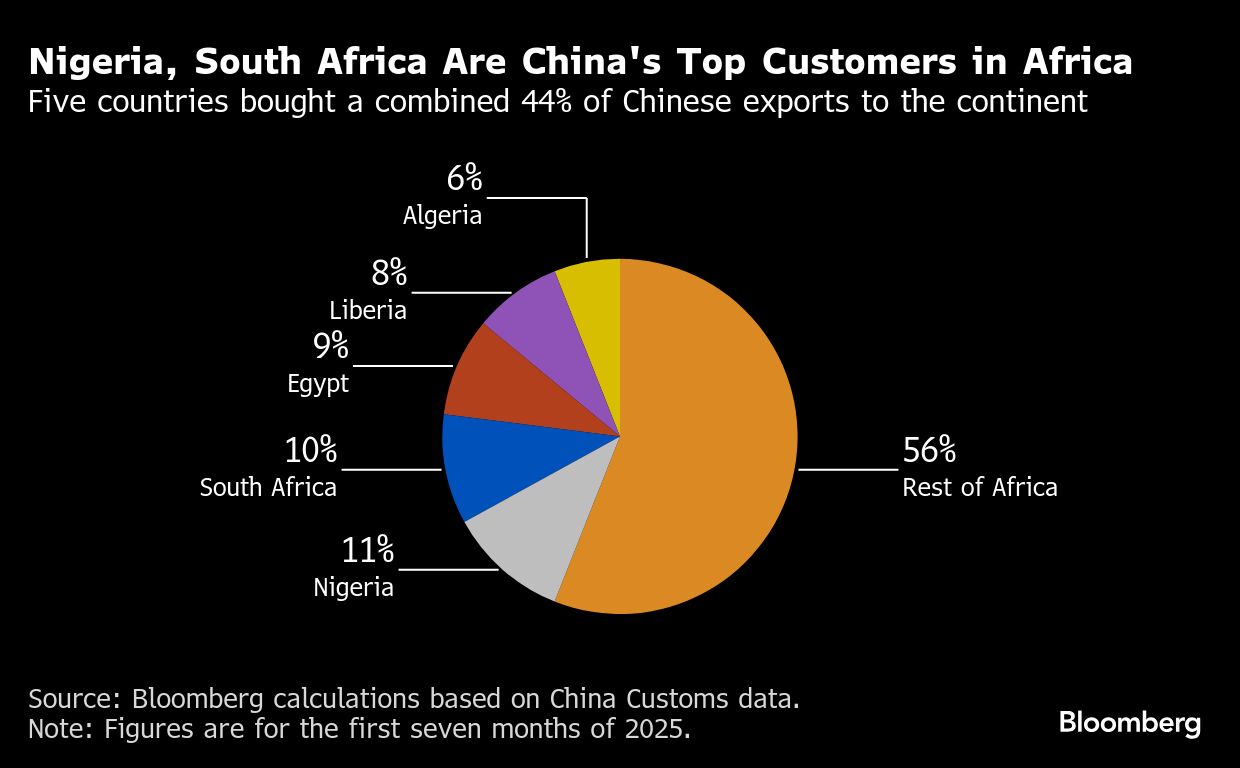
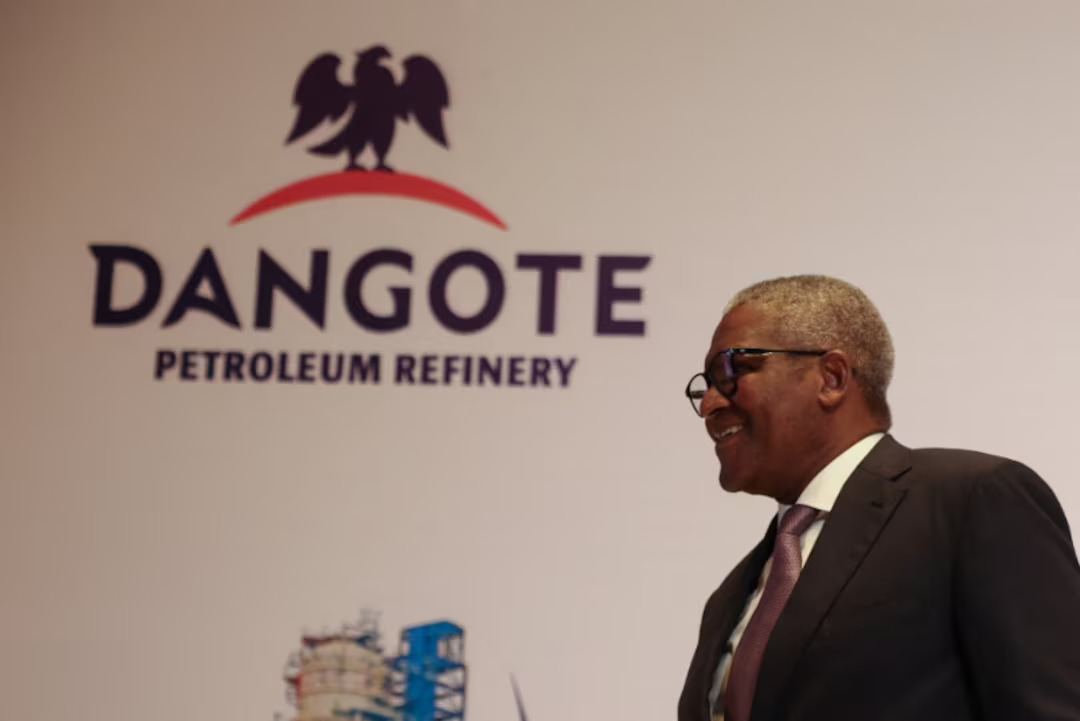
China's Top Customers in Africa, with Nigeria, South Africa and Egypt at the top. Image: Bloomberg
Trade: The Foundation of Profit
Trade remains the most significant channel through which China generates returns from Africa. China-Africa trade reached a record US$275 billion in 2024, with African exports to China totalling US$93 billion.
China has positioned itself as a major market for African commodities and, increasingly, for value-added products. In May 2026, China implemented zero-tariff treatment for 53 African countries with diplomatic relations, becoming the first major economy to offer unilateral, full coverage zero-tariff treatment to all African diplomatic partners.
The results have been immediate. In the two months following implementation, Chinese imports from Africa reached 193.8 billion yuan, a 23.5 percent year-on-year increase. Imports of aquatic products and textile materials both grew by double digits, while specialty fruits such as avocados, apples, oranges and grapefruits increased by 130 percent, 89.6 percent, 27.9 percent and 11.9 percent respectively.
This trade generates returns for China through multiple channels: Chinese consumers access affordable goods, Chinese companies involved in logistics and distribution profit, and the bilateral relationship creates goodwill that facilitates other economic engagements.
Manufacturing: Higher Margins Abroad
Chinese manufacturing companies operating in Africa have discovered that profit margins can be significantly higher than in China's saturated domestic market.
The cement industry offers the clearest example. By the end of 2025, Chinese cement companies had nearly 40 million tonnes of production capacity in Africa, accounting for almost 25 percent of the continent's total cement capacity.
The profit differential is striking. West China Cement's 2024 data showed gross profit per tonne of cement in Africa at 323 yuan, compared to just 42 yuan in China — nearly eight times higher. In 2025, the company's overseas markets contributed 80 percent of gross profit with just 40 percent of sales volume.
Country-level performance varies but remains lucrative. Ethiopia averages 422 yuan per tonne, Mozambique reaches 603 yuan per tonne, and Congo commands 878 yuan per tonne.
This profitability stems primarily from favourable supply-demand dynamics rather than lower production costs. Africa's cement consumption per capita is only about 140 kilogrammes annually, compared to much higher levels in developed markets, creating significant growth potential.
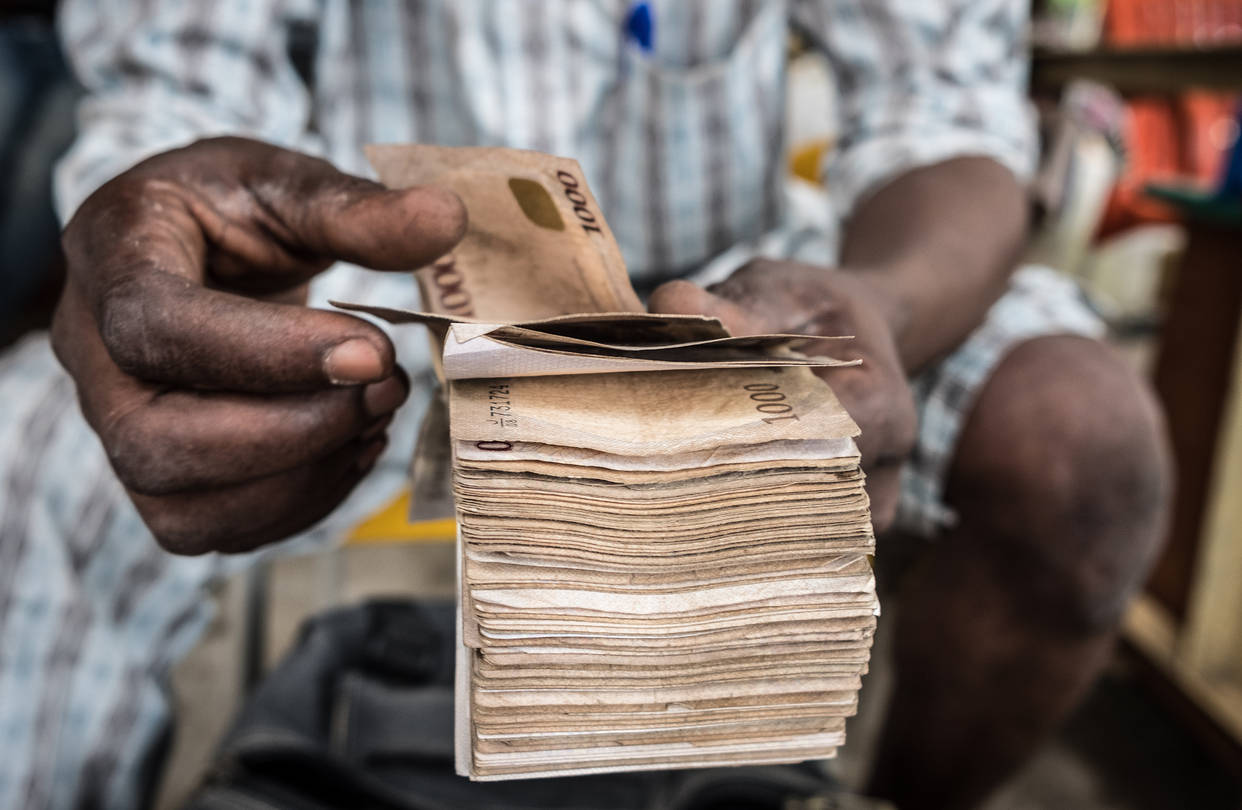
Nigeria, South Africa and Egypt are among the four countries on the continent that already have bilateral currency swaps with the central bank in Beijing – a list that includes Mauritius. Image: Bloomberg
Industrial Parks: Creating Self-Sustaining Ecosystems
Chinese investment in African industrial parks represents another sophisticated revenue model. These parks serve as platforms that house multiple Chinese enterprises, generating returns through land leases, factory rentals and service fees.
The Kilifi Special Economic Zone in Kenya, developed by Chinese state-owned enterprise Wuyi Industrial, illustrates this model. Located 24 kilometres from Mombasa port, the 3,000-acre park offers tax incentives including a 10 percent corporate tax rate for the first decade and 15 percent for the second, compared to the standard 30 percent.
The park provides comprehensive support services — land, factory buildings, warehousing and assistance with registration, taxation, employment and legal matters. Products manufactured in the zone with qualifying local content can access the East African Community, the Common Market for Eastern and Southern Africa, and preferential access to European and American markets.
For smaller investors, private industrial parks have emerged with attractive returns. In Nigeria's Ogun State, investing approximately 400,000 yuan to build a 1,000-square-metre factory generates annual rent of 170,000 to 180,000 yuan, yielding a three-year payback period.
The Debt Question: Returns Through Repayment
The "debt trap" narrative has dominated Western discussions of China-Africa relations, but the reality is more nuanced. Chinese loans to Africa have entered a repayment phase, with funds flowing back to China as countries service their debts.
In 2024, new Chinese loans to Africa fell to US$2.1 billion from US$4.6 billion the previous year. More significantly, net public capital flows from China to Africa turned negative — repayments now exceed new disbursements.
Kenya's experience illustrates the scale. The country pays approximately US$1 billion annually to service Chinese debt, primarily for the Standard Gauge Railway. While passenger and freight volumes have grown, operating revenue of about US$165 million remains far below debt repayment obligations.
However, the "debt trap" framing obscures several facts. China accounts for only about 9 percent of Africa's external debt, while private creditors hold 42 percent. Chinese loans typically feature longer maturities and grace periods than commercial alternatives. And the infrastructure built with Chinese financing generates economic value that can support debt servicing.
Agriculture and Value Addition
Chinese investment in African agriculture is creating new profit streams while transforming local value chains. In Kenya, Chinese company Shengmai Industrial invested in avocado oil processing, producing refined oil for export to China, Europe and American markets.
The timing was fortuitous. Kenya is Africa's largest avocado producer and second-largest exporter, and the first African country to export fresh avocados to China. The zero-tariff policy has made exports more profitable, with savings reinvested in farmer training and technical support.
This model generates returns through processing margins while creating stable markets for smallholder farmers. The avocado oil factory has created employment for local youth, including analytical chemists and quality control technicians.
The Structural Reality: Interdependence
The relationship between China and Africa has evolved into one of structural interdependence rather than simple exploitation. China needs African minerals — cobalt, lithium, manganese — for its battery and electric vehicle industries. It needs markets for its manufactured goods. It needs reliable partners for its Belt and Road Initiative.
Africa needs Chinese infrastructure financing, particularly as traditional Western donors impose governance conditionalities that many governments find restrictive. Africa needs access to Chinese markets. Africa needs Chinese technology and manufacturing expertise.
Neither Beijing nor African capitals has an interest in resolving too quickly the question of who, between creditor and debtor, holds the other by the sleeve. An over-indebted country has little means to refuse a new Chinese project. But a country that stops repaying deprives Beijing of a revenue stream its own public banks need.
Conclusion: Beyond Simplistic Narratives
China makes money in Africa through a diversified portfolio: trade in commodities and value-added goods, long-term infrastructure concessions, manufacturing operations with higher margins than domestic markets, industrial park development, agricultural processing and loan repayment. The system has evolved from simple resource extraction to complex operational partnerships.
This evolution reflects both Chinese learning from past challenges and African agency in negotiating terms. The "debt-trap" narrative, while politically potent, obscures a more complex reality of mutual economic interest, calculated risk-taking and evolving partnership models. Understanding how China actually makes money in Africa requires moving beyond ideological framings to examine the concrete mechanisms through which value is created and captured.
The relationship will continue to evolve as African countries develop greater negotiating capacity, as Chinese firms refine their operational models and as global economic conditions shift. What remains constant is the fundamental logic: China makes money in Africa because Africa offers opportunities that China can profitably exploit, and Africa engages with China because China offers terms that other partners do not.
With reporting from the China-Africa Business Council, the African Development Bank, the World Bank, the International Monetary Fund and various academic sources.











Comments (0)
No comments yet. Be the first to share your thoughts!