


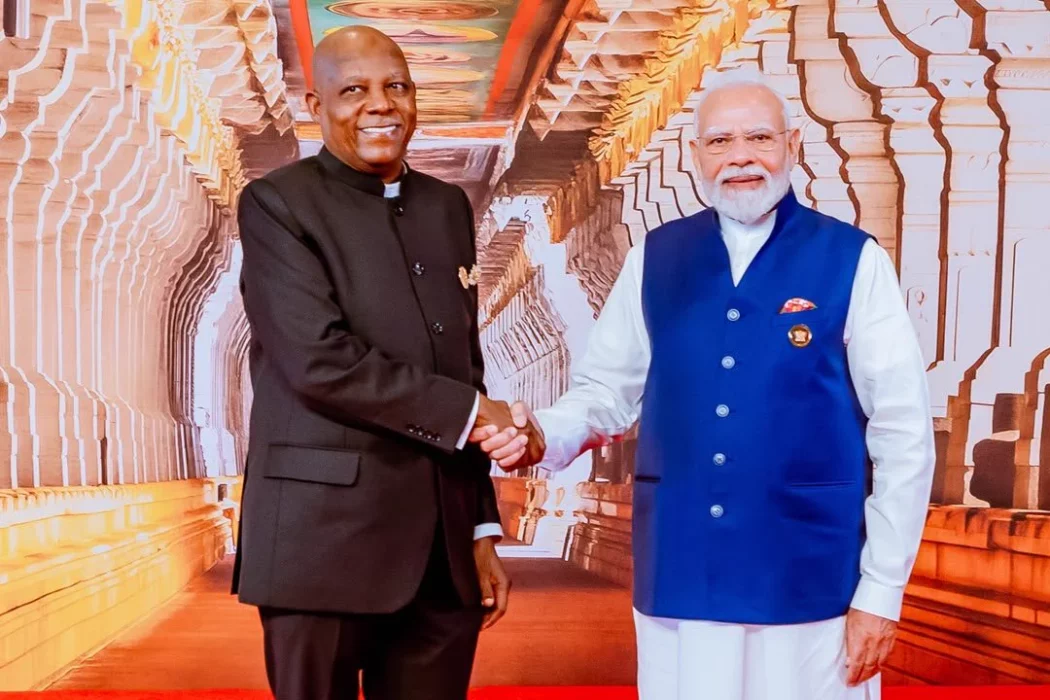
Speaking at the 18th BRICS Leaders' Summit in New Delhi, India, in an address delivered on his behalf by Vice President Kashim Shettima, Tinubu declared that "a nation that owns no technology risks renting its future." The summit, which brought together leaders from Brazil, China, Egypt, Ethiopia, India, Indonesia, Iran, Russia, Saudi Arabia, South Africa and the United Arab Emirates, concluded with the adoption of the New Delhi Declaration, a 140-point document outlining shared priorities on trade, technology, energy and global governance.
A Call for Technology Sovereignty
Tinubu's central message was that Nigeria and other developing economies must transition from being consumers of technology to becoming producers of it. He challenged BRICS countries to deepen cooperation with developing economies in sectors that can strengthen their productive capacity.

"We welcome deeper BRICS cooperation in artificial intelligence, digital public infrastructure, fintech, telecommunications, cybersecurity, biotechnology and advanced manufacturing, because developing countries must produce technology, create knowledge and own intellectual property," Tinubu said. "A nation that owns no technology risks renting its future."
The President framed Nigeria's engagement with BRICS as a practical platform for expanding trade and investment, accelerating technology transfer and developing human capital. He said cooperation should extend to infrastructure, connectivity, energy, agriculture, healthcare, education and industrialisation, supported by development finance.
Positioning Nigeria as a Gateway to Africa
Tinubu used the summit to pitch Nigeria as a strategic destination for global investment, urging investors to see the country as a gateway to Africa's rapidly expanding single market under the African Continental Free Trade Area.
"We welcome BRICS cooperation in trade, agriculture, food security, energy, infrastructure, manufacturing, healthcare and critical minerals, especially partnerships that advance technology transfer, local value addition, industrial capacity and employment," he said.
The President identified Nigeria's youthful and dynamic population as a major economic asset, noting that with a population of 250 million people and an average age of 16.9 years, the country's greatest asset is its young and dynamic population whose imagination drives its innovation agenda. He cited initiatives including the 3MTT programme, Project BRIDGE and national AI programmes as key areas of investment in digital skills, entrepreneurship, research and technology-enabled businesses.
The New Delhi Declaration: AI and Digital Fraud Take Centre Stage
The New Delhi Declaration, unanimously adopted by the 11 BRICS member countries, placed significant emphasis on artificial intelligence and digital fraud. BRICS leaders emphasised the need for an AI system that is trustworthy, inclusive, energy-efficient and aligned with the needs of the Global South.
The declaration called for the implementation of the BRICS Leaders' Statement on the Global Governance of Artificial Intelligence, building on discussions held at India's AI Impact Summit and the World AI Conference in Shanghai. Leaders underscored that international cooperation on AI should support a "just, fair, equitable and prosperous future," with particular attention to ensuring Global South countries are not left behind in AI development.
On digital fraud, the declaration expressed "serious concerns" over the rampant proliferation of organised cross-border fraud operations, including the exploitation of digital technologies and payment systems to target vulnerable individuals. These operations often use fake investment platforms, romance scams and fraudulent job offers to defraud victims before laundering proceeds through digital payment channels.
The declaration called for stronger cooperation between customs authorities, financial intelligence units, law enforcement agencies, tax authorities and supervisory bodies, while asking telecommunications providers and technology platforms to improve information-sharing and adopt data analytics to detect and disrupt money laundering schemes earlier. It also welcomed the establishment of a BRICS Central Bank Hub for capacity building and endorsed conducting cybersecurity exercises on an annual basis.
Global Governance and Financial System Reform
Beyond technology, Tinubu called for an urgent overhaul of global governance structures and international financial institutions, declaring that the institutions shaping the world order must be reformed to reflect contemporary economic and demographic realities.
"Nigeria supports a more representative, equitable and responsive global governance architecture, including reform of the United Nations Security Council and the international financial system," he said. "BRICS amplifies the voice of the Global South and advances a more inclusive international order, consistent with Nigeria's call for institutions that reflect contemporary economic and demographic realities."
Tinubu made Nigeria's case for "a BRICS partnership that moves from dialogue to delivery, from commitments to implementation, and from cooperation to measurable development outcomes."
Nigeria's BRICS Journey
Nigeria formally joined BRICS as a partner country in January 2025, becoming the ninth partner country alongside Belarus, Bolivia, Cuba, Kazakhstan, Malaysia, Thailand, Uganda and Uzbekistan. The partner-country category was created at the 16th BRICS Summit in Kazan, Russia, in October 2024. Brazil, which held the bloc's presidency at the time, said Nigeria's large population, position as Africa's most populous country and role in promoting South-South cooperation made it a natural addition to the expanded BRICS framework.
The partner-country status allows Nigeria to participate in selected BRICS activities and engage with the bloc's initiatives, potentially opening opportunities in areas such as trade, investment and cross-border financial cooperation.
Looking Ahead
Tinubu expressed Nigeria's readiness to contribute to a BRICS partnership that is resilient enough to withstand global shocks, innovative enough to embrace emerging opportunities, cooperative enough to advance shared prosperity and sustainable enough to protect future generations.
"Our partnerships must create jobs, expand trade, transfer technology and strengthen our nations' productive capacity," he said. "We must build a future in which Africa moves from the margins of global development to the frontiers of global growth and innovation."
The summit also saw Indian Prime Minister Narendra Modi highlight initiatives including BRICS CONNECT, the BRICS MSME Cooperation Portal and the BRICS Urban Mobility Hub, aimed at supporting skills development, employment, enterprise growth and knowledge-sharing among member and partner countries.
With reporting from Xinhua, The Economic Times, Business Standard, The Hindu, Nairametrics, and the Government of India.











Comments (0)
No comments yet. Be the first to share your thoughts!