
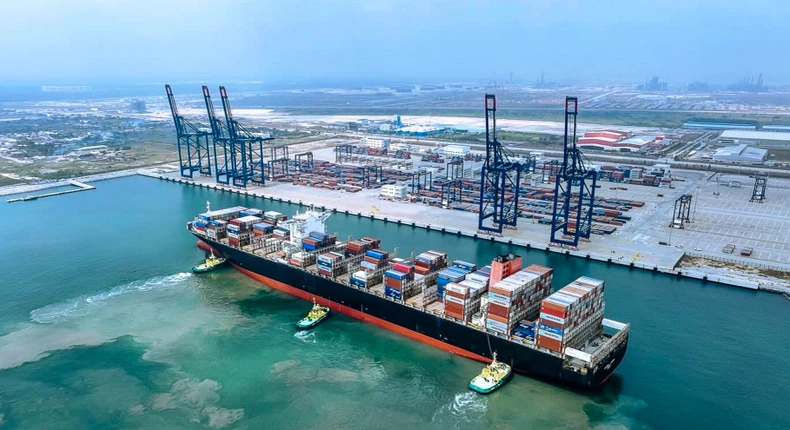
The agreement was signed in Luanda on July 20 by the state-owned Barra do Dande Development Company (SDBD), Chinese firm Huatong Angola Industry and financial partner Berkshire Waterhouse Infrastructure Development Ltd. The deal covers a 25-year sub-concession for the construction and operation of the terminal, with the possibility of renewal depending on commercial performance.

A Private Sector-Driven Investment
Addressing the signing ceremony, Roque Saraiva, chairman of SDBD, confirmed that two separate instruments were signed: the first for the port terminal sub-concession valued at approximately $450 million and the second for supporting infrastructure bringing the total planned investment to $900 million.
"This is entirely a private-sector investment," Saraiva said, emphasising that strategic partners would be involved in the project's development.
João Rufino, representing Berkshire Waterhouse, noted that the funds would be released in phases as the project receives the required approvals. The investment will finance the construction of the terminal, energy facilities and access roads connecting the port to industries operating within the free trade zone.
Construction Timeline and Capacity
The project will be implemented in three phases:
- Phase One: Expected to take 24 months before the port begins handling exports from factories in the Barra do Dande Free Trade Zone
- Phases Two and Three: Scheduled for completion between 2029 and 2030, with the terminal fully constructed
Once fully developed, the terminal will be able to receive ships carrying up to 80,000 tonnes, with project promoters expecting the facility to generate more than $10 billion in turnover.
"In the first phase, we're going to create more than 21,000 jobs," said Secretary of State for Civil Aviation, Maritime and Port Sectors, Adilson Catala. He described the project as a strategic step toward transforming Angola into a leading logistics, industrial and commercial hub in Africa.
Addressing Logistics Bottlenecks
For Huatong, the investment is about more than building a port—it's about removing a major obstacle facing industries already operating in Barra do Dande.
Huatong Angola Industry chairman Zhang Wendong said the terminal would improve regional transport connections, increase Angola's logistics capacity and support industrial expansion. He noted that limited port infrastructure currently restricts the movement of goods produced within the industrial complex.
"Currently, the limited port logistics capacity hinders the full flow of production from the industrial park," Zhang said, requesting greater political support from Angolan authorities for the terminal's future operation, including the allocation of maritime routes and better coordination of the country's logistics network.
A Free Trade Zone Taking Shape
The Barra do Dande Free Trade Zone was established to attract manufacturers, reduce Angola's dependence on oil and create about 21,000 jobs.
Already operational within the zone:
- Sino-Ord Integrated Industrial Park: Comprising more than 10 manufacturing plants
- Huatong's Aluminium Industrial Park: The first phase started production in January 2026, creating 1,200 direct jobs and another 800 indirect jobs
- Edible Oil Refinery: Under construction, scheduled for completion by mid-2028
Huatong previously invested $250 million in the first phase of the aluminium project and plans to spend an estimated $1.6 billion across five phases over the next eight to ten years.
A Shifting Investment Model
The Barra do Dande port deal reflects a broader shift in China's investment strategy in Africa—moving from large government-backed loans toward privately financed, commercially viable projects . The agreement also signals deepening bilateral cooperation between Angola and China, coming as Angola prepares to mark 25 years of post-conflict reconstruction in 2027—a period during which China played a decisive role in developing the country's major infrastructure .
Angolan Transport Minister Ricardo Viegas D'Abreu noted during a recent mission to Beijing that the next phase of Angola-China cooperation should be increasingly oriented toward sustainable investment models, economically viable projects and balanced risk-sharing.
With reporting from Business Insider Africa, Angop, Transportes & Negócios, ECO, Ver Angola, and Macau Business.