


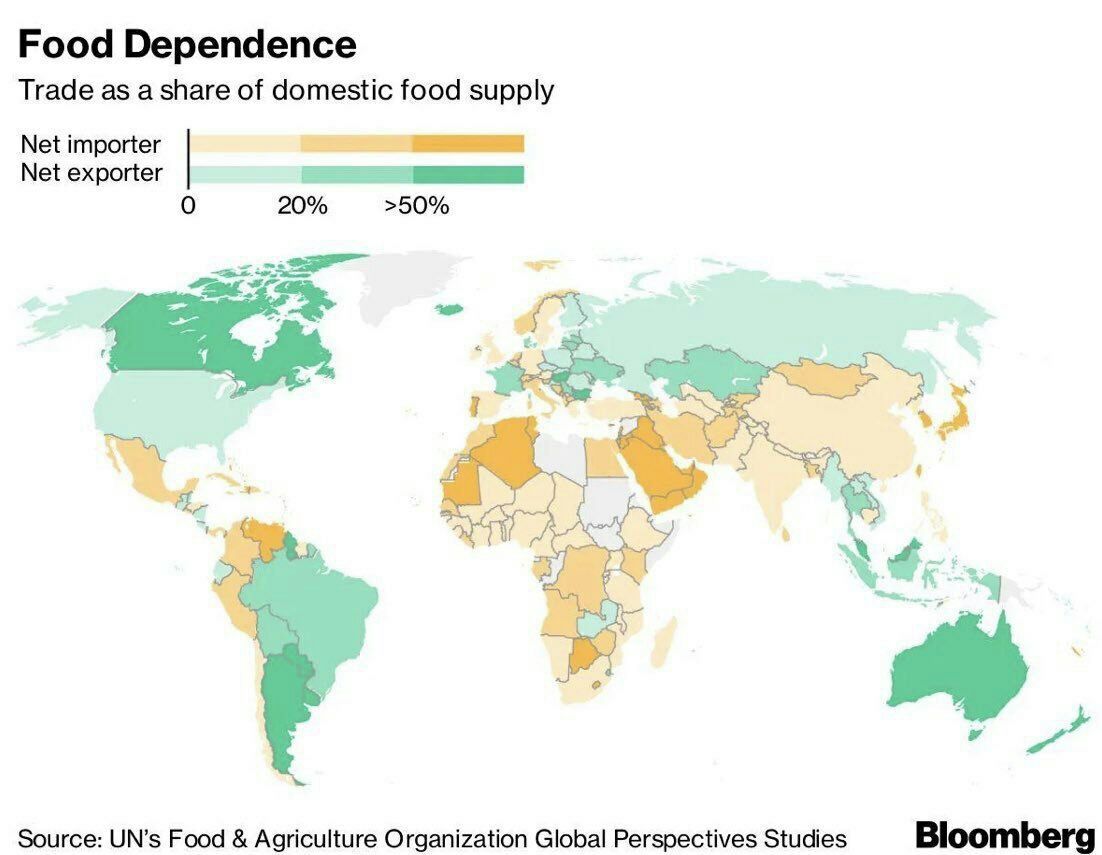
Africa is sitting on one of the world's greatest agricultural opportunities, yet millions of tonnes of food are imported into the continent every year. The contradiction is striking: a continent blessed with enormous amounts of arable land, diverse climates and generations of farming knowledge still depends heavily on global food markets.
The Bloomberg graphic above, based on studies from the UN Food and Agriculture Organization, illustrates how different regions depend on food trade. But Africa's problem is not simply a shortage of land. It is a combination of underinvestment, weak agricultural infrastructure, changing farming practices, poor policies and increasing dependence on external agricultural inputs.

Africa’s Land Is Not The Problem
Africa is frequently described as holding around 60% of the world's remaining uncultivated arable land. However, having potentially cultivable land is very different from having productive farmland.
Large parts of the continent lack reliable irrigation, modern storage facilities, farm-to-market roads, electricity, affordable financing and efficient distribution networks. Millions of smallholder farmers remain dependent on rainfall, making agricultural production vulnerable to droughts and increasingly unpredictable weather.
After harvesting, another problem emerges. Poor storage and transportation can cause significant food losses before crops reach consumers. Meanwhile, countries spend billions importing wheat, rice, maize, cooking oils and other food products that could potentially be produced locally at competitive prices.
Africa therefore does not suffer simply from a lack of farmland. It suffers from a failure to turn its agricultural potential into a modern, productive food system.
What happened to Africa's Traditional Farming Knowledge?
Long before modern agricultural corporations entered African markets, communities had developed farming systems suited to their local environments. Farmers preserved seeds from successful harvests, rotated crops, used animal manure and relied on indigenous knowledge to determine what grew best in particular soils and climates.
Traditional African seeds were often adapted over generations to local conditions. But modernization and commercial agriculture gradually changed this relationship.
Hybrid commercial seeds, synthetic fertilizers and other agricultural inputs promised higher yields and faster production. For farmers struggling with poverty and food insecurity, the promise of producing more from the same piece of land was understandably attractive.
The problem arises when farmers become dependent on purchasing seeds and inputs every planting season rather than maintaining diverse, locally adapted seed systems.
The GMO and Fertilizer Debate Is More Complicated
Companies such as Bayer, which acquired Monsanto, have faced substantial criticism over genetically modified crops, herbicides, seed patents and the broader model of industrial agriculture.
But calling all genetically modified seeds "toxic" is scientifically too broad. GMO is a method of producing a crop, not a description of whether that crop is poisonous. Approved genetically modified foods are not inherently toxic simply because they are genetically modified.
The more serious debate concerns agricultural dependency, biodiversity, corporate control of seeds, pesticide use and environmental consequences. Excessive or poorly managed synthetic fertilizer can contribute to soil degradation, water pollution and greenhouse-gas emissions. Heavy dependence on a narrow range of commercial varieties can also reduce agricultural biodiversity.
This does not mean Africa should reject every modern agricultural technology. Rather, it should determine which technologies genuinely serve African farmers.
Africa Needs an Agricultural Renaissance
The answer is not to return completely to the past or blindly embrace everything labelled "modern." Africa needs to combine its traditional knowledge with useful modern technology.
That means investing in irrigation, research, agricultural extension services, local seed banks, improved storage, roads, processing facilities and affordable financing. Indigenous crops such as sorghum, millet, cassava, beans and many locally adapted varieties deserve greater investment alongside modern crop science.
Africa does have the potential to feed itself and become a major global food supplier. But land alone cannot accomplish that.
The real question is whether African nations will build food systems in which African farmers control more of their seeds, production and markets or remain consumers in a global agricultural system while importing food from elsewhere.










Comments (0)
No comments yet. Be the first to share your thoughts!